Debt, inflation and gold: what are the experts forecasting?

National debt, inflation and the gold price have a habit of moving in the same direction.

When government borrowing rises, the money supply tends to expand. That puts upward pressure on inflation, and ultimately makes scarce assets like gold increase in price over time.

But why should businesses and households across the UK care? Quite simply, because the purchasing power of your savings are at stake. Knowing what comes next is the best way to protect the purchasing power of your savings.

So what does the future hold for these market forces? 

Here are the latest forecasts from Barclays and J.P. Morgan, alongside Ray Dalio’s commentary.

UK national debt: the problem

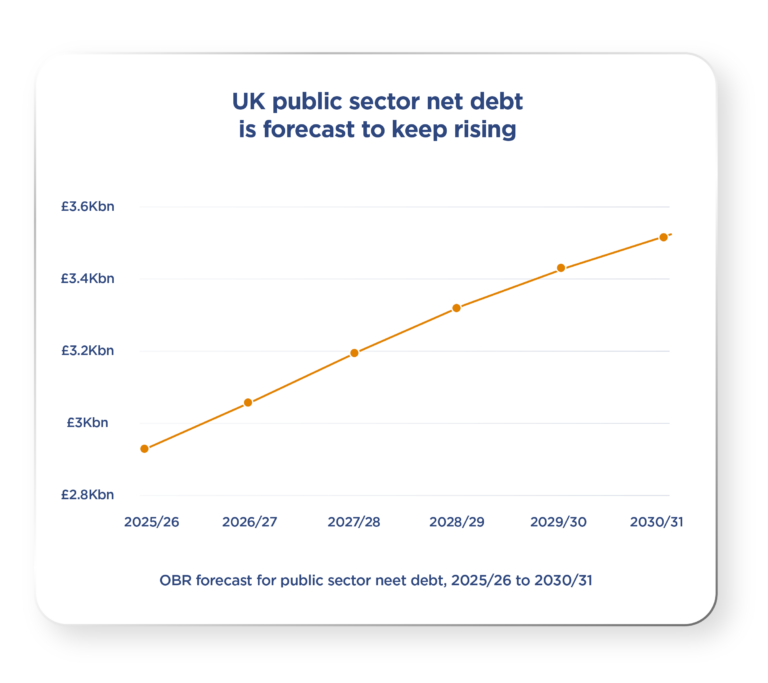
The UK’s national debt reached £2.99 trillion in June 2026. This staggering amount equates to 94.9% of GDP, and if that wasn’t bad enough, it isn’t showing any signs of slowing down.

The Office for Budget Responsibility (OBR) expects it to continue to increase to around £3.5 trillion by 2030/31.

The real problem is the cost of servicing that debt. In 2025/26, the UK spent around £109 billion just on paying the interest, approximately 8% of all public spending. To put that into perspective, that is more than we spend on policing and defence combined.

Latest official forecasts

Spoiler alert: the UK’s national debt is expected to grow.

Forecaster’s database of forecasts for the UK economy was last updated in June 2026. Here are the latest official forecasts on UK public sector borrowing in 2026/27: 

    • Capital Economics: £153.3bn
    • Barclays: £128bn
    • JP Morgan: £105bn

Renowned investor and Bridgewater Associates founder, Ray Dalio has also weighed in on the UK’s national debt problem warning that in order to keep up with the rising interest costs, the government will be forced to borrow more, leading to higher national debt and thus higher interest costs. 

This looks like a debt death spiral in the making because it will require more borrowing to service the debt…” – Ray Dalio

The trend to watch: UK public sector net debt is nearing 100% of GDP. This is a major warning sign that suggests inflation and currency debasement will persist.

UK inflation: the symptom

In July 2026, UK CPI inflation jumped back up to 2.9%. 

This is well above the Bank of England’s target of 2% and the reality is inflation has been above target for a long time.

Households and businesses across the UK are already feeling the compounding effects of elevated inflation. What’s less obvious is that in the context of the national debt crisis, inflation is actually useful to governments as a way of diluting the real value of the debt.

The problem is that inflation also dilutes the real value of your hard-earned money. This is how the cost of reckless government borrowing is quietly passed on to regular people and businesses.

So what does the outlook for UK inflation look like from here?

Latest official forecasts

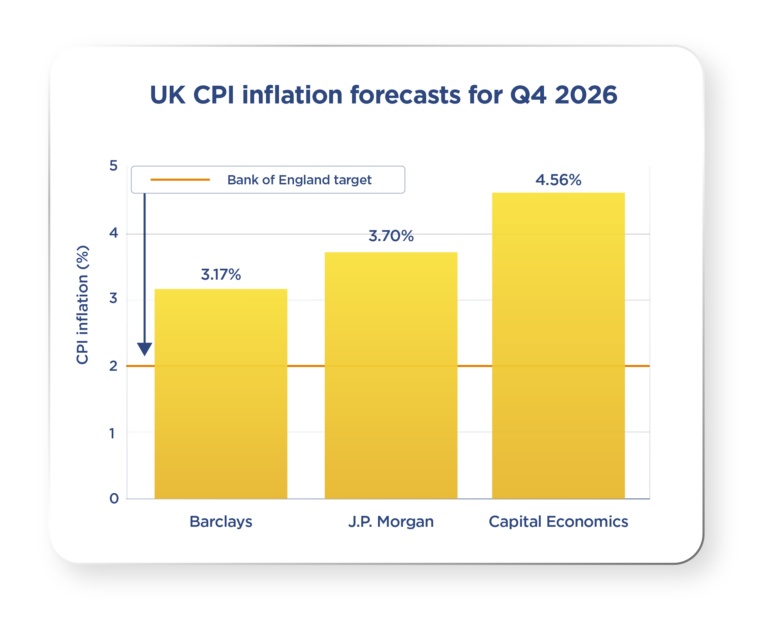
In line with higher government borrowing forecasts, the major market voices are widely expecting UK inflation to increase even further in 2026. Here are the latest official forecasts from HM Treasury’s June 2026 comparison of independent forecasts:

  • Capital Economics: 4.56%
  • J.P. Morgan: 3.70%
  • Barclays: 3.17%

If the national debt crisis wasn’t bad enough, analysts are citing higher energy costs resulting from conflict in the Middle East as a catalyst for persistent inflation.

Bank of England Governor Andrew Bailey has been equally clear about the direction of travel:

Inflation is likely to go higher over this year as utility bills rise and firms pass higher costs through supply chains.

The trend to watch: If energy prices spike or remain elevated, the ripple effect on transport, production and supply-chain costs could put upward pressure on UK inflation.

The gold price: the hedge

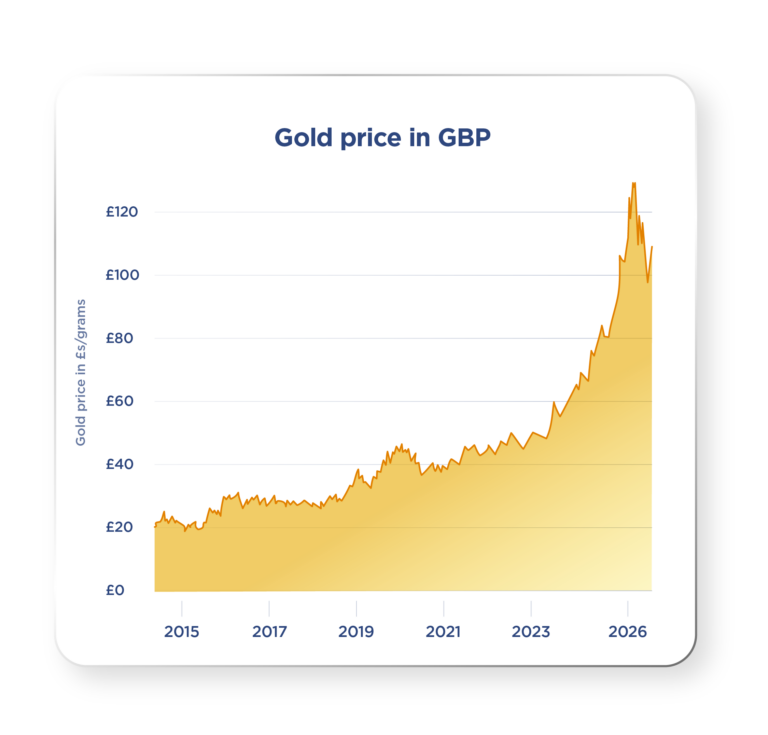
Gold has already had an extraordinary run, and analysts seem to be widely expecting prices to continue growing.

National debt, persistent inflation, conflict, energy prices and central bank buying continue to feature heavily in most forecasts.

Latest market forecasts

Here are the latest official forecasts of the price of gold per ounce by the end of 2026:

Ray Dalio has also shared his view on the future of gold, and he remains strongly bullish on its outlooks as national debt levels across Western economies, including the UK, rise and confidence in fiat currencies like the pound sterling weaken:

The big story in the investment world was the depreciation of the value of fiat money and how that impacted the price of gold.

The trend to watch: As government debt, money supply and inflationary pressures continue to grow, demand for a scarce, globally recognised asset like gold could grow significantly too.

Gold’s new role in the global financial system

Many people are still unaware of gold’s upgraded standing in the global financial system. After the financial crisis of 2008, under the Basel III framework, gold was formally recognised as a tier 1 asset. This means that allocated gold held in a bank’s own vaults can receive a 0% risk weighting, reflecting its lack of credit risk.

This is because gold is a neutral, globally recognised monetary asset with no issuing government or counterparty, and a limited supply.

Against this backdrop, central banks have been accumulating gold at historically high rates. By the end of 2025, gold represented around 27% of global official reserves by value, compared with 22% for US Treasuries, putting gold ahead of US Treasuries for the first time in roughly three decades. This reflects both central-bank demand and the substantial increase in gold’s market price.

For both businesses and households across the UK, gold ownership represents a hedge against inflation and the debasement of the pound sterling. Those who move funds and savings into gold now could very well protect their purchasing power over time.

Forecasts are opinions and may not prove accurate. Gold prices can fall as well as rise. Past performance is not a reliable indicator of future performance. Comparisons with savings accounts are illustrative only and do not reflect differences in risk, liquidity or capital protection. This article is for information only and does not constitute investment, tax or financial advice.


Continue Reading

How much gold is actually in the World Cup?

What does Wimbledon prize money tell us about the value of money?

Would you pay £25,000 for a football match? The economics of World Cup ticket inflation.

Real World Examples

  1. Fancy a coffee? Use your TallyMoney Mastercard. Boom – paid. (Yes, you’re buying a flat white with gold. How amazing is that?)

  2. Need cash? Use any Mastercard ATM worldwide or spend across the globe. ZERO fees from us, ZERO markup. (When you spend or withdraw, your gold converts instantly at the global spot price. No catches, no hidden charges – just straight-up Mastercard exchange rates. Because your money shouldn’t cost you… more money.)

  3. Want some money back in your bank? Just tap ‘transfer’ in the app. (Though after a while, you might wonder why you’d want to…)

    Zero faff. Zero waiting. Zero fees when you spend tally.

Meet Cameron Parry

Meet the guy who wouldn’t accept being trapped in a ‘heads they win, tales we lose’ government-run monetary system that protects and benefits the financial institutions, to the detriment of the public. Where people’s deposits are constantly at risk, and losing value through inflation caused by central bankers and politicians.

If necessity is the mother of invention, then frustration may be the roommate’s cousin of motivation. In any case, he decided to stop getting mad and start a new monetary system with sound money. Where deposits serve the depositor, where savings build wealth for savers, and transactions are made in a familiar way. And he called it TallyMoney.

TallyMoney: Gold upgraded

With TallyMoney:

  • Your pounds instantly become physical gold (1 tally = 1mg of real gold)
    Stored in Swiss vaults (not under your bed)
  • Fully insured and allocated (actually yours, not a paper promise)
  • Spend it anywhere with your TallyMoney debit Mastercard
  • Transfer back to pounds instantly if needed (but why would you?)

We’re not anti-bank because it’s trendy. We’re anti-bank because the current system is rigged against you. Every day you leave money in a “savings” account, you’re funding their profits while your wealth evaporates.

Enter gold: the original currency

Why gold? It’s value is universally acknowledged.

  • It’s not controlled by any single government
  • It can’t be printed or manufactured
  • It’s actually scarce 
  • It requires effort to extract it 
  • It doesn’t rust, decay, or disappear
  • It has remarkable properties

So while the pound’s lost 50% of its value since 2004, gold’s grown by 146% in the last decade alone. While your bank savings got mugged by inflation, gold owners were laughing all the way to… well, not the bank.

But here’s the rub: Traditional gold ownership is a right pain. Buy physical bars? Prepare for storage fees that’ll make your eyes water, insurance premiums that never end, and a 5-10% haircut when you need to sell. Plus, try buying your weekly shop with a gold ingot.
Paper gold ETFs? They’re classed as Tier 3 assets for a reason – that’s financial speak for “risky as hell.” You don’t own gold, you own a promise. A tradeable IOU. And when everyone wants their gold at once? Good luck with that. So you’re stuffed either way: real gold that’s impossible to use, or fake gold that might not be there when you need it.
Until now.

The truth about inflation

How? Well, when politicians overspend (and they invariably do), they need more money to ‘stimulate the economy’. But raising taxes makes voters angry. So what do they do? They fire up the money printer, and boy do they love to print. To give you a sense of the scale, since 2015 the Bank of England has created £520bn out of thin air through “quantitative easing” (electronic money printing) plus £86bn in physical currency. 

Thing is, more pounds in circulation = each pound is worth less. Think about it: In 2004, £100 could buy you a decent night out, theatre tickets, and a cab home. Today? That same £100 barely covers the theatre tickets. Your money didn’t disappear – it was diluted, like someone’s been topping up your whisky with water when you weren’t looking.

The “2% inflation target” they bang on about? That’s them telling you they plan to steal 2% of your wealth every single year. And calling it healthy.

How TallyMoney actually works?

  1. First things first: we’ve got actual gold bullion* (none of that paper-promise nonsense) locked up tight in a Brinks vault in Switzerland. Yeah, those Brinks – the security legends who’ve been protecting valuables since Queen Victoria was on the throne.

  2. You send your pounds to your TallyMoney account (bye-bye, inflation-addicted fiat!).

  3. We use the global gold spot price to instantly turn your currency into its weight in gold. No hidden or fuzzy exchange rates, just the real market gold price + 1.49% gold purchase fee.

  4. Each milligram of your physical gold = 1 tally (we keep it decimal because no one wants to faff about with troy ounces – the specific unit for measuring gold).

  5. That’s it! Your app shows your balance in tally, but remember – those aren’t just numbers on a screen. That’s your solid gold, in milligrams, sitting pretty in Switzerland.
  6. You can now save and spend your gold as you see fit.

*All Tally gold is sourced from LBMA-accredited providers because we’re rebels with a cause… and standards. Instead of tracking the gold price per kg, your money is directly converted based on the real-time global gold spot price.

TallyMoney is 
real money

  1. Store of value
    Your gold sits in a Swiss vault (not getting ‘quantitatively eased’ away)
    Evidenced by 5,000 years of holding its value
    Can’t be inflated by government whim and fingers on the ‘currency print’ button
  2. Medium of exchange
    Spendable at 150+ million shops worldwide (thanks, Mastercard)
    Currency converts instantly at market rates (no sneaky margins)
    Moves as quickly as sending a text 
  3. Unit of account
    1 tally = 1mg of gold. Simple
    Stable enough to actually plan your future with
    Speaks every currency’s language (gold’s kind of a big deal everywhere)

This is why TallyMoney is so much more than just owning Gold – it’s a real financial revolution. We’re not just helping you own gold; we’re bringing back what money was always meant to be. Sound Money for a Brighter Future. Because your hard work and wealth deserve better than being slowly robbed by external forces.

We want you to have real money

  1. A store of value:
    Keeps its value over time
    Insulated from devaluation/inflation
    Actually rare and can’t be created out of thin air
  2. Medium of exchange:
    Easy to use for everyday transactions
    Widely accepted
    Can be transferred efficiently
  3. Unit of account:
    Works like a proper value-measuring stick (imagine if your ruler shrunk every year – mad, right?)
    Splits nicely into useful bits
    Reliable enough to plan your future with

Why does this matter? Because your hard work deserves better than being turned into monopoly money by someone else’s actions. Every time your currency loses value (inflation) its stealing from your past work, which harms your present savings, and your future dreams.