What is money – In everyday language

Money is something we use everyday and there is not much in life that we can do without it. But have you ever considered what money actually is? As a ‘gen Z’ I hadn’t given much thought about money until I started working for Tally!

It only takes a quick Google search to find the definition of money as ‘a medium for exchange in the form of banknotes and coins’. This is obviously how we are familiar with money today but wind back the clock a few hundred years and money has taken many different forms, from commodity based money such as gold and silver to the more unusual forms such as feathers and even teeth!

When gold was linked to money in the 1600s it was, as you can imagine, a physical burden carrying around heavy, precious metals. The receipts people received from exchanges became a form of money in itself, which led to the creation of banknotes that we know today. This period of exchanging banknotes in return for gold was known as the Gold Standard.

The Gold Standard ended in 1931, however, it may amaze you like it did me, that the words ‘I promise to pay the bearer the sum of five/ten/twenty/fifty pounds’ appear on every banknote in circulation today and have done for many years. 300 years ago, the promise on the note stated the bearer could be paid five/ten/twenty/fifty pounds equivalent value in gold. Although today this is no longer the case, with Tally you can now seamlessly transfer, spend or save in gold without the physical burden!

Although it is hard to gauge an exact figure of how much money is in circulation today, according to the Bank of England, it is surprising that just 4% of all money in the UK is held in physical form as cash which is made up of approximately 3.9 billion Bank of England notes, worth about £71 billion. The other 96% of money in the UK is held as electronic money.

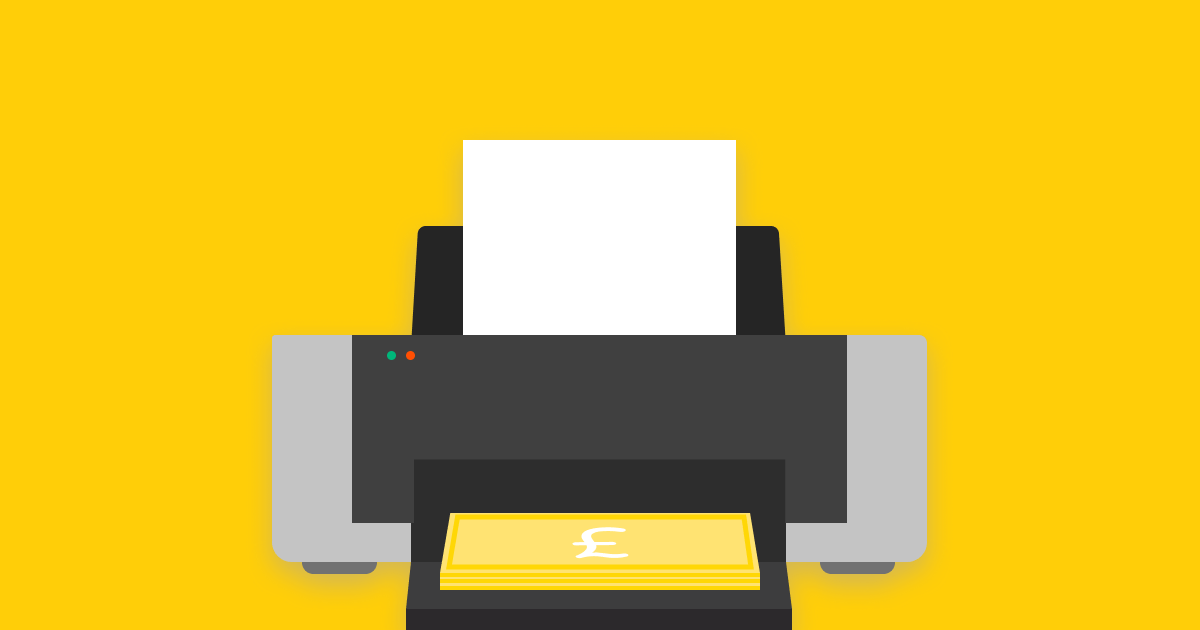
In these very strange times we currently live in, the government has been forced to rapidly ‘print’ more money which although short term is a necessity, will soon have long term ramifications.

How is it possible for the government to create extra money?

Quantitative easing involves the creation of new digital money as opposed to printing new physical banknotes – so much for money growing on trees! The new digital money is then used to buy government bonds or other financial assets to inject money into the economy, with the idea that this will boost spending and investments to stimulate the economy in times of need.

In March 2020, the government announced a quantitative easing programme where the purchases of government bonds will total £645 billion. Creating this amount of extra money in turn dilutes the value of our money such as savings in bank accounts and can increase the rate of inflation, reducing the purchasing power of our money.

The government and banks often use complicated language making areas surrounding our money seem much more complex. In this case it is easy to believe more money is being ‘printed’ to help the economy, albeit a necessity, without understanding what this can mean longer term for the value of the money in our pockets.

So, although the prices of items we know and love may inevitably increase, for the first time Tally provides you a choice in the money you use, as an alternative to government-issued money. By having a gold backed account you can transfer, deposit, save and spend money that is gold with insulation from economic uncertainty without the inconvenience that came with owning gold 300 years ago!


Continue Reading

How to beat the hidden tax on your savings

Are your savings working for you, or a bank?

Saving strategies: how often should you save?

Let’s get physical: How much gold bullion and printed fiat currency actually exists?

Why Faster Payments aren’t always so fast

How to get a TallyMoney account

Real World Examples

  1. Fancy a coffee? Use your TallyMoney Mastercard. Boom – paid. (Yes, you’re buying a flat white with gold. How amazing is that?)

  2. Need cash? Use any Mastercard ATM worldwide or spend across the globe. ZERO fees from us, ZERO markup. (When you spend or withdraw, your gold converts instantly at the global spot price. No catches, no hidden charges – just straight-up Mastercard exchange rates. Because your money shouldn’t cost you… more money.)

  3. Want some money back in your bank? Just tap ‘transfer’ in the app. (Though after a while, you might wonder why you’d want to…)

    Zero faff. Zero waiting. Zero fees when you spend tally.

Meet Cameron Parry

Meet the guy who wouldn’t accept being trapped in a ‘heads they win, tales we lose’ government-run monetary system that protects and benefits the financial institutions, to the detriment of the public. Where people’s deposits are constantly at risk, and losing value through inflation caused by central bankers and politicians.

If necessity is the mother of invention, then frustration may be the roommate’s cousin of motivation. In any case, he decided to stop getting mad and start a new monetary system with sound money. Where deposits serve the depositor, where savings build wealth for savers, and transactions are made in a familiar way. And he called it TallyMoney.

TallyMoney: Gold upgraded

With TallyMoney:

  • Your pounds instantly become physical gold (1 tally = 1mg of real gold)
    Stored in Swiss vaults (not under your bed)
  • Fully insured and allocated (actually yours, not a paper promise)
  • Spend it anywhere with your TallyMoney debit Mastercard
  • Transfer back to pounds instantly if needed (but why would you?)

We’re not anti-bank because it’s trendy. We’re anti-bank because the current system is rigged against you. Every day you leave money in a “savings” account, you’re funding their profits while your wealth evaporates.

Enter gold: the original currency

Why gold? It’s value is universally acknowledged.

  • It’s not controlled by any single government
  • It can’t be printed or manufactured
  • It’s actually scarce 
  • It requires effort to extract it 
  • It doesn’t rust, decay, or disappear
  • It has remarkable properties

So while the pound’s lost 50% of its value since 2004, gold’s grown by 146% in the last decade alone. While your bank savings got mugged by inflation, gold owners were laughing all the way to… well, not the bank.

But here’s the rub: Traditional gold ownership is a right pain. Buy physical bars? Prepare for storage fees that’ll make your eyes water, insurance premiums that never end, and a 5-10% haircut when you need to sell. Plus, try buying your weekly shop with a gold ingot.
Paper gold ETFs? They’re classed as Tier 3 assets for a reason – that’s financial speak for “risky as hell.” You don’t own gold, you own a promise. A tradeable IOU. And when everyone wants their gold at once? Good luck with that. So you’re stuffed either way: real gold that’s impossible to use, or fake gold that might not be there when you need it.
Until now.

The truth about inflation

How? Well, when politicians overspend (and they invariably do), they need more money to ‘stimulate the economy’. But raising taxes makes voters angry. So what do they do? They fire up the money printer, and boy do they love to print. To give you a sense of the scale, since 2015 the Bank of England has created £520bn out of thin air through “quantitative easing” (electronic money printing) plus £86bn in physical currency. 

Thing is, more pounds in circulation = each pound is worth less. Think about it: In 2004, £100 could buy you a decent night out, theatre tickets, and a cab home. Today? That same £100 barely covers the theatre tickets. Your money didn’t disappear – it was diluted, like someone’s been topping up your whisky with water when you weren’t looking.

The “2% inflation target” they bang on about? That’s them telling you they plan to steal 2% of your wealth every single year. And calling it healthy.

How TallyMoney actually works?

  1. First things first: we’ve got actual gold bullion* (none of that paper-promise nonsense) locked up tight in a Brinks vault in Switzerland. Yeah, those Brinks – the security legends who’ve been protecting valuables since Queen Victoria was on the throne.

  2. You send your pounds to your TallyMoney account (bye-bye, inflation-addicted fiat!).

  3. We use the global gold spot price to instantly turn your currency into its weight in gold. No hidden or fuzzy exchange rates, just the real market gold price + 1.49% gold purchase fee.

  4. Each milligram of your physical gold = 1 tally (we keep it decimal because no one wants to faff about with troy ounces – the specific unit for measuring gold).

  5. That’s it! Your app shows your balance in tally, but remember – those aren’t just numbers on a screen. That’s your solid gold, in milligrams, sitting pretty in Switzerland.
  6. You can now save and spend your gold as you see fit.

*All Tally gold is sourced from LBMA-accredited providers because we’re rebels with a cause… and standards. Instead of tracking the gold price per kg, your money is directly converted based on the real-time global gold spot price.

TallyMoney is 
real money

  1. Store of value
    Your gold sits in a Swiss vault (not getting ‘quantitatively eased’ away)
    Evidenced by 5,000 years of holding its value
    Can’t be inflated by government whim and fingers on the ‘currency print’ button
  2. Medium of exchange
    Spendable at 150+ million shops worldwide (thanks, Mastercard)
    Currency converts instantly at market rates (no sneaky margins)
    Moves as quickly as sending a text 
  3. Unit of account
    1 tally = 1mg of gold. Simple
    Stable enough to actually plan your future with
    Speaks every currency’s language (gold’s kind of a big deal everywhere)

This is why TallyMoney is so much more than just owning Gold – it’s a real financial revolution. We’re not just helping you own gold; we’re bringing back what money was always meant to be. Sound Money for a Brighter Future. Because your hard work and wealth deserve better than being slowly robbed by external forces.

We want you to have real money

  1. A store of value:
    Keeps its value over time
    Insulated from devaluation/inflation
    Actually rare and can’t be created out of thin air
  2. Medium of exchange:
    Easy to use for everyday transactions
    Widely accepted
    Can be transferred efficiently
  3. Unit of account:
    Works like a proper value-measuring stick (imagine if your ruler shrunk every year – mad, right?)
    Splits nicely into useful bits
    Reliable enough to plan your future with

Why does this matter? Because your hard work deserves better than being turned into monopoly money by someone else’s actions. Every time your currency loses value (inflation) its stealing from your past work, which harms your present savings, and your future dreams.